From the Crew
Sealcoat vs. Crack Fill vs. Resurfacing: How to Tell What Your Driveway Actually Needs
Customers call us all the time asking for sealcoating when what they actually need is crack filling. Or they ask for crack filling when the driveway is genuinely past the point where either one will help, and what they need is a resurface. We don't blame anyone for the confusion — the three sound similar, and the asphalt industry isn't great at explaining the difference. Here's the short version.
The fast diagnostic
Before we get into the details, here's the rough decision tree we use when we walk a driveway:
- Surface looks gray, sun-faded, dry, but no significant cracks: sealcoat.
- Visible cracks, but most are hairline and the asphalt is still structurally sound: crack fill, then sealcoat on top.
- Big cracks (more than ~1½″ wide), alligator cracking, potholes, or the surface flexes when you walk on it: resurface, not seal.
That's the cheat sheet. Now here's why each one exists and what it actually does.
What sealcoating actually is
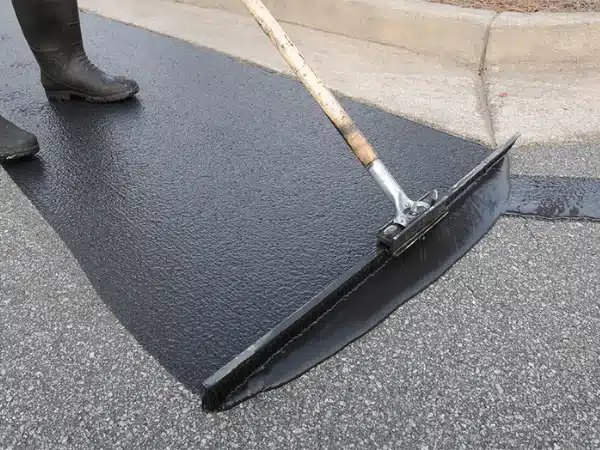
Sealcoating is a protective coating applied to the top of asphalt-based pavements. It's a liquid-applied product — usually coal-tar emulsion or asphalt emulsion — that goes on with squeegees, brushes, or spray equipment in one or two coats. Once it cures (24–48 hours), you've got a fresh black surface that protects the asphalt underneath from water, oil, UV damage, and oxidation.
That's it. That's all sealcoating does. It is a protective layer, not a structural one. It does not fill cracks of any meaningful size, it does not level out depressions, it does not strengthen weak asphalt. If your driveway is structurally sound but looks old and faded, sealcoating gives you another five to seven years of life and a much better-looking surface for about a tenth of what new asphalt costs. If your driveway is structurally failing, sealcoating is lipstick on a pig — it'll look great for two weeks and then the underlying problems come right back through.
What crack filling does (and doesn't) do
Crack filling is exactly what it sounds like — hot rubberized asphalt sealant pumped into existing cracks to keep water out. The materials are liquid asphalt, asphalt emulsions, or cutbacks. The application is straightforward: we wire-brush and blow out debris from the crack, then inject the hot sealant to full depth and squeegee it level.
There are some practical limits. Crack filling works on non-working cracks — cracks in areas with limited movement. A filler is appropriate for cracks under about a half inch wide. A sealer handles cracks roughly half-inch to two inches wide. Cracks wider than that, or cracks that have webbed into "alligator" patterns where the asphalt has effectively broken into chunks, are past the crack-filling stage.
Why fill cracks at all? Because the single fastest way to destroy an asphalt driveway is to let water get under it. Once water penetrates through a crack and saturates the base, every freeze-thaw cycle widens the damage. Filling cracks the year you notice them is the cheapest paving decision you'll ever make. Ignoring them for three winters is how you turn a $400 crack-fill job into a $6,000 resurfacing job.
When you actually need resurfacing (or full replacement)
If your driveway has any of the following, sealing it won't help and crack filling won't be enough:
- Cracks consistently wider than 1½″
- Alligator cracking (a web of interconnected cracks that look like reptile skin)
- Potholes
- Surface flex underfoot when you walk on it
- Standing water in any low spots after a rain
- Edges crumbling away or "raveling" (small bits of asphalt loose on top)
Those are signs that the asphalt itself, or the base underneath it, has failed. At that point you have two choices: an overlay (laying a new 1.5–2″ lift of fresh asphalt over a properly prepped existing surface) or a full removal and replacement. Which one is right depends on how bad the existing base is — that's a judgment call we make on site, and we'll tell you straight.
The combo move: crack fill, then seal
For driveways that are almost at the sealcoat-only stage but have some hairline cracks starting, the right call is usually crack fill first, then sealcoat over the top. The crack filler locks water out of the existing cracks; the sealcoat protects everything else. We do this combo a lot — it's usually the right answer for a 10–15-year-old residential driveway that's been well-cared-for.
How often should you sealcoat?
Every 3–5 years is the common answer, and it's roughly right for residential driveways. Parking lots that see daily traffic, oil drips, and heavier loads may need it more often. Driveways in full sun and exposed to a lot of UV degrade faster than shaded ones. The honest answer is: when the sealcoat starts looking gray and sun-bleached again, it's time. Don't overdo it — sealcoating too often can actually build up too much surface layer and start delaminating.
What we recommend you actually do
Walk your driveway with fresh eyes — ideally after a rain, so any low spots show up as puddles. If it looks faded but solid: get a sealcoat quote. If you see cracks but they're hairline: get a crack fill + seal quote. If you see anything from the resurfacing list above: get a resurfacing or replacement quote.
Or skip the diagnostic and call us. We'll walk it with you, tell you straight which of the three you need, and write you a number for it. That's free, and there's no obligation to use us. We'd rather you not buy the wrong service from anyone — including us — than buy the wrong service from us and call us angry six months later.
Got a question we haven’t answered? Call (530) 896-1727 or send us a message — we’re happy to walk through it.